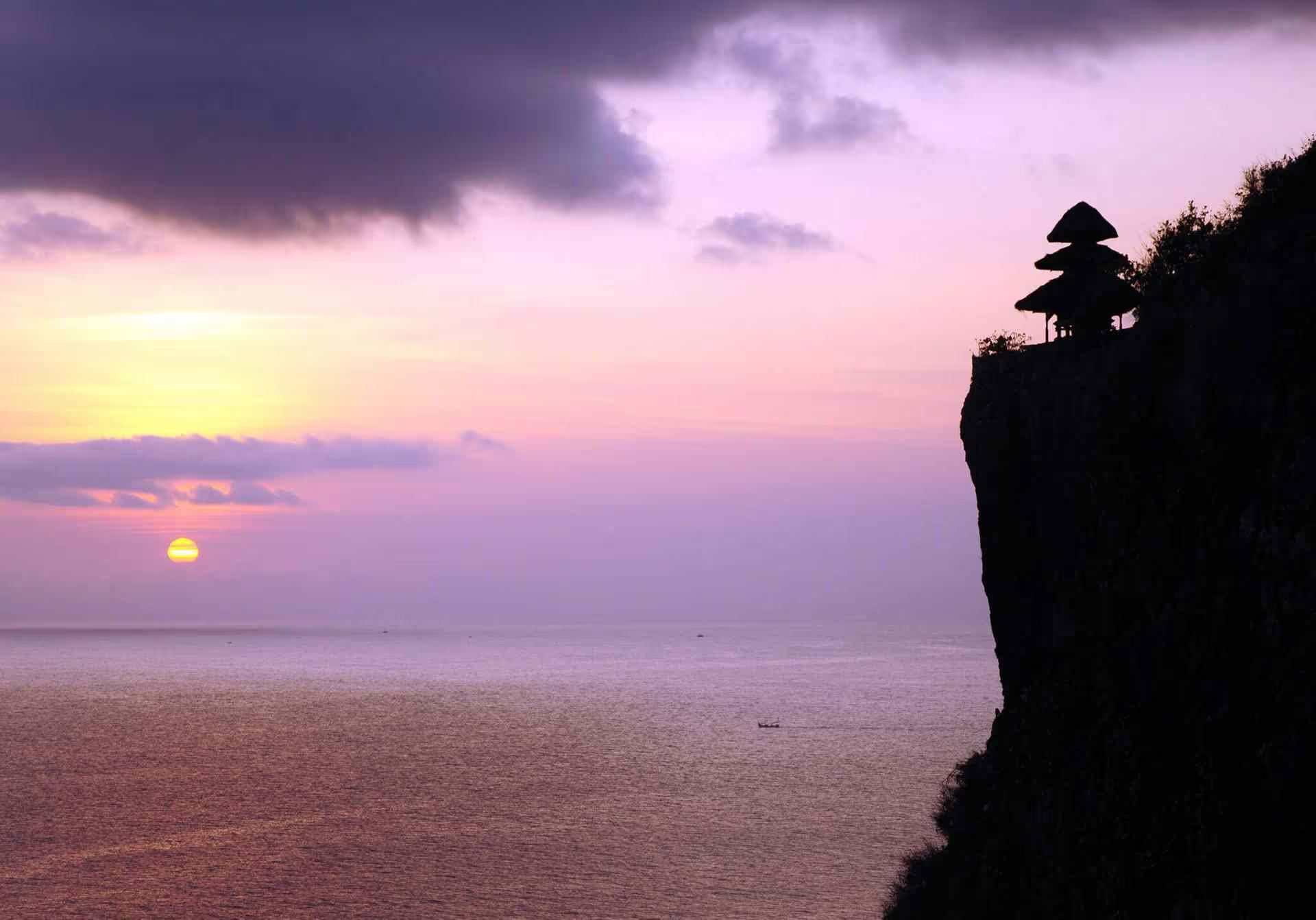
Thousands of temples. Gentle people. Volcanoes touching the clouds. A Hindu soul inside the world's largest Muslim archipelago — Galungan, Nyepi, offerings at dawn. Beautiful people. Bali.
ADVICES
BALI
BALI
Bali is the most important Indonesian tourist destination, with a reputation of being one of the most beautiful tourist spots in Asia, is visited by millions of visitors from all over the world every year.
Here you will find many beaches, surf spots, dive sites, temples, culture, art, shopping, nightlife.
Tourism is mainly concentrated in the southern coastal areas, where the resorts villages of Kuta, Canggu and Seminyak, are the most known destinations for their beaches, the surf, nightlife and stunning sunsets.
Here it's full of shops, hotels, restaurants, shopping centres and nightlife, suitable for those seeking a lively holiday.
Sanur, on the east coast, is a quiet area with many large hotels and the only sea-side walk path.
Ubud, located uphill, is considered the heart of artisans and culture. Among green tropical jungle and rice plantations, its rural serenity is closer to the original Balinese spirit.
The southern most part, the Bukit peninsula, is slighly drier area which boasts the most beautiful beaches and waves for brave surfers.
Near the Airport, Jimbaran is well known for its beach, the grilled fish restaurants and its fish market.
CLIMATE
CLIMATE
Eight degrees south of the equator, Bali has a tropical climate with two main seasons, dry from May to September and wet from October to April.
The average temperature is around 29 degrees Celsius.
LANGUAGES
LANGUAGES
Indonesian and Balinese languages are spoken here together with a bit of English.
In addition to these languages, numerous local dialects are spoken, with diverse idioms for castes and clans.
Bahasa Indonesia, the inter-island language, uses both the script and the phonetic, of the roman alphabet.
This means one symbol/character one sound, all times.
So, except for English native speakers, the Indonesian language is quite easy to read and pick up on your own.
Add that grammar and syntax are even simpler that the simplest Western languages, English, and that might mean that you can really enjoy the learning curve.
Think it like this, when you start to be able to listen, understand and speak a bit, you'll really, actually, start to have a glimpe of what this wonderful culture and life balance is all about. The cultural detachment, that closed door inside your mind, starting to open. It is that easy.
GEOGRAPHY
GEOGRAPHY
Bali, with an area of about 5,561 square km, is located among the islands of Java and Lombok and it is one of the 18,000+ islands in the Indonesian archipelago.
It's crossed by a strip of volcanic mountains. The highest one, Gunung Agung, reaches 3.031 metres on sea level.
Bali, populated by 4.317.000 inhabitants as of 2020, with a density of 750 people per square km, is administratively a province of Indonesia with Denpasar being the province centre.
For more infos have a look here.
Time zone here is UTC+08.
The south regions are home to rice terraces that are the among the most spectacular in the world.
The north of the island offers the best sea bed for snorkelling and scuba diving, with Menjangan natural park, the village of Lovina and Amed famous for dolphins.
East of Bali the small island of Nusa Lembongan, a peaceful place formerly inhabited only by seaweed farmers is where you still find a slow atmosphere.
CULTURE
CULTURE
Balinese people have strong spiritual roots and despite the large influx of tourists over the years their local culture is still extremely alive.
Bali is famous for its artisans. Painting, sculpture and wood carving are the most developed artistic activities, flourishing particurarly in the Ubud area.
Traditional Balinese music Gamelan, as well as the traditional dances of Legong, Barong and Kecak are also followed by a large population. Following Hindu tradition, Balinese cremate their dead.
Cremations celebration look more like Westerners Folk Festival, than a Western funeral.
There is a procession around the village, Gamelan music and offerings are deposited on the coffin of the deceased in a joyful atmosphere.
Think... the pain of existance has ended, let's celebrate the departed memory and make the deceased live on.
Colourful offerings are made to the gods every day, placed in the front of shops, homes and temples.
Crafted with an eye for detail and beauty, these offerings were formerly made in each households with manual labor, the actual offer, but nowadays they are often bought at markets or dedicated shops.
Most of the population in Bali live in villages, in extended large families and participate actively to the village social life, countless ceremonies, following the Balinese calendar of 210 days.
Celebrations and cerimonies are carried out for the many gods at 20,000+ temples all over the island.
GODS & SPIRITUALITY
GODS & SPIRITUALITY
92% of the population adheres to Balinese Hinduism, which differs a lot from the original Indian Hinduism.
Agama Hindu Dharma is a combination of local ancestral animist beliefs and Hinduism rituals, which has spread in the archipelago during the Majapahit empire times in the eleventh century.
With the arrival of Islam in neighbouring Java, during the fifteenth century, many kings fled to Bali with their court's entourage, artists, musicians and artisans, to avoid islamisation.
In Bali today small minorities practice other religions. Islam (5.7%), Christianity (1.4%) and Buddhism (0.6%).
FESTIVITIES
FESTIVITIES
Bali's main festival is Galungan. It involves the whole island and is an annual Wuku calendar event.
It lasts 10 days, during which gods are believed to descend to earth for the festivities.
Now the Barong, a mythical creatures half lion half dog, travels from temple to temple and from village to village.
Kuningan is the highlight of the festival on the last day.
Nyepi is the main festivity of the Saka calendar. It's the last day of the Balinese year and usually falls between late March and early April.
The day before is considered a time of purification when evil spirits are removed with cymbals, gongs, drums and torches.
The day of Nyepi everyone remains at home, in silence, without light nor cooking.
The malignant deities must see Bali deserted and leave the island in peace for another year.